
President Ruto Questions Unusual Election Results in East Africa
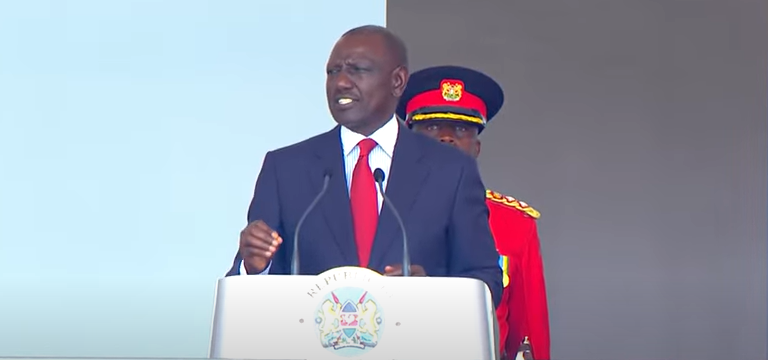
President William Ruto of Kenya has expressed skepticism about the re-election of President Samia Suluhu of Tanzania, suggesting that such a decisive outcome would be “unthinkable” in Kenya. However, he avoided directly challenging the credibility of Tanzania’s October 29 General Election.
During an interview on Al Jazeera, Ruto was asked about the integrity of elections in the region, particularly the Tanzanian poll where President Suluhu was declared the winner with over 98% of the vote. He stated, “In a democracy — for example, in Kenya — you can never get 96%.” This remark highlights his concerns about the unusual nature of the results in Tanzania.
Ruto also acknowledged that countries in the region have made varying levels of progress in democratic practices. He defended the 2021 victory of Ugandan President Yoweri Museveni, despite the United States labeling it as flawed. “I attended President Museveni’s swearing-in in the last election, and I think he got 57%. He did not get 90%,” Ruto said during the interview.
While not directly criticizing his Tanzanian counterpart, Ruto implied that such lopsided outcomes raise legitimate questions about electoral competitiveness across the region. “It is not for me to judge Tanzania,” he added. “Every country has its own way of doing their stuff, but democracy is a work in progress.”
The President emphasized that, despite its imperfections, democracy in East Africa remains essential for political stability and good governance. “It is not always easy, you know, because there are all manner of moving parts. But I think we must work together to ensure that we protect democracy,” he said. He also stressed the importance of listening to alternative views without resorting to violence.
Kenya’s Democratic Record
Ruto defended Kenya’s democratic record, dismissing fears that his administration could erode hard-won political freedoms. “There are countries like Kenya that are way ahead [and] others that are catching up. There are others that are still not yet started,” he said.
He framed the debate within a global context, noting that even established democracies face new pressures. “We see, for example, in the West, people moving more right, others moving to the left, and everything in between,” Ruto said. He referenced the January 6 riot in the United States, stating, “Who expected that we would have the kind of situation we had in the US in the previous election? Nobody expected that Congress — that Capitol Hill — would [be] attacked. That looked far-fetched, yet that is the world we live in.”
AU Reports Flawed Elections in Tanzania
Ruto’s comments coincided with a report from the African Union (AU) Election Observation Mission, which faulted Tanzania’s October 2025 General Election for failing to meet international standards. The report cited opposition boycotts, violence, and an internet blackout that affected transparency.
In a preliminary report released on November 5, the AU Mission led by former Botswana President Mokgweetsi Masisi stated that the electoral environment “before, during, and after” the vote was not conducive to peaceful and credible elections. Masisi called on Tanzania to undertake urgent constitutional and political reforms to restore public trust and strengthen democratic accountability.
“At this preliminary stage, the Mission concludes that the 2025 Tanzania General Elections did not comply with AU principles, normative frameworks, and other international obligations and standards for democratic elections,” the Masisi-led Mission observed. It also noted that the preparedness of the electoral commission and other institutions was inadequate to address the challenges that compromised the integrity of the elections.
Regional Concerns and Democratic Challenges
The remarks come amid growing scrutiny of electoral integrity and civic freedoms in East Africa. Disputed elections in Tanzania and Uganda, along with increasing concerns over shrinking democratic space in several countries, have raised alarms among regional and international observers.
As the region grapples with these challenges, the need for transparent and inclusive electoral processes becomes more critical than ever. The AU’s findings underscore the urgency for reforms to ensure that future elections reflect the true will of the people and uphold democratic values.