
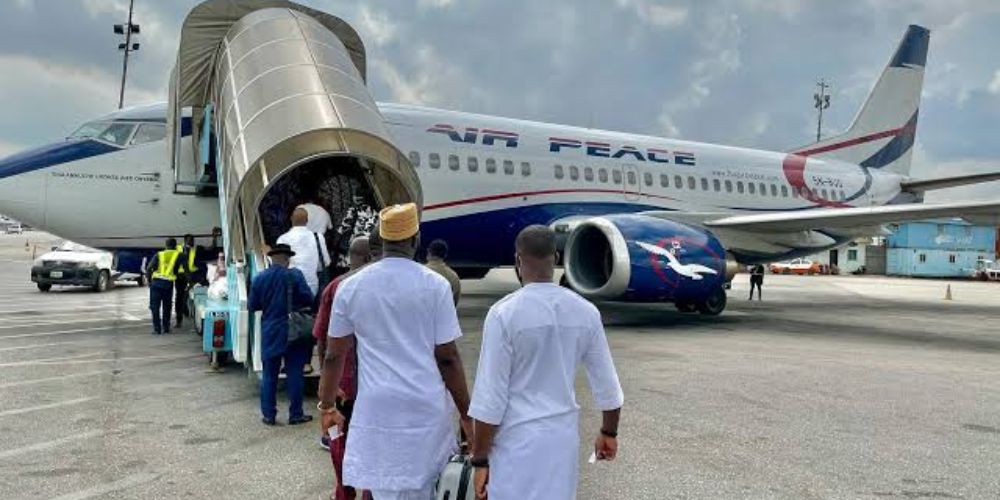
Senate Committee Criticizes NSIB Report on Air Peace Runway Incident
The Nigerian Senate Committee on Aviation has raised concerns about the report released by the Nigerian Safety Investigation Bureau (NSIB) regarding an incident that occurred on July 13, 2025, at the Port Harcourt International Airport involving Air Peace airline. The NSIB’s interim report attributed the runway overrun to alleged drug use by the pilots, which it claimed affected the captain’s decision-making during landing.
Senator Abdulfatai Buhari, the Chairman of the Committee, expressed dissatisfaction with the findings, stating that the report contained “serious inconsistencies and uncoordinated findings” that could harm the country’s reputation in the global aviation industry. The committee conducted a one-day investigative hearing, which included representatives from key aviation stakeholders such as the Federal Airport Authority of Nigeria (FAAN), the Nigeria Civil Aviation Authority (NCAA), the Airlines Operators Association of Nigeria, and Air Peace’s Chairman/CEO, Mr Allen Onyema.
During the hearing, the committee also discussed broader issues related to aviation safety in Nigeria and ways to improve services to restore traveler confidence. Senator Buhari criticized the NSIB for presenting contradictory information, particularly when it initially accused multiple Air Peace crew members of drug use before narrowing the allegations to just two individuals. He emphasized that most of these claims were unfounded and warned against making false accusations in the aviation sector, where international bodies like ICAO closely monitor operations.
Buhari commended Air Peace and other local airlines for their internal safety protocols and random testing of pilots and staff. He argued that the country should support these initiatives rather than undermine them with unverified claims. “Air Peace and United Nigeria Airlines are our own. We need to support them, not damage their reputation with unverified claims,” he said.
He further noted that no lives were lost in the incident, and the aircraft was not damaged. It was towed and later returned to Lagos safely. The committee plans to recommend measures to enhance the quality of aviation investigations in Nigeria, focusing on improving safety standards.
Buhari also hinted at a potential new bill that would require federal agencies and government officials to use Nigerian airlines, aiming to boost their growth and expansion.
Mr. Allen Onyema, CEO of Air Peace, addressed the committee, expressing concern over the NSIB’s report and the public response that blamed the airline. He stated that the incident did not involve mechanical faults or damage to the aircraft. Instead, it was attributed to human error. Onyema clarified that the aircraft involved in the incident suffered no damage and was able to return to Lagos the same day.
He added that the pilot involved had nearly 40 years of experience and had simply had a bad day. However, the early report created confusion, making it seem as though the aircraft was faulty or the pilots were intoxicated. Onyema highlighted that Air Peace maintains a self-regulating culture that is stricter than many foreign airlines. He shared an example where the airline grounded eight aircraft in a single day after discovering a maintenance error, reporting it to the NCAA despite the option to conceal it.
Despite these efforts, the Minister of Aviation and Aerospace Development, Mr. Festus Keyamo, cautioned against releasing sensitive information about the NSIB’s report, which is still ongoing. He warned that an interim report could be misinterpreted and potentially harm the final outcome of the investigation. Keyamo urged the committee to wait for the full report before making any conclusions.
Key Takeaways from the Hearing
- Inconsistent Findings: The NSIB’s report faced criticism for its contradictions and lack of coordination.
- Support for Local Airlines: The committee emphasized the importance of supporting indigenous airlines like Air Peace.
- Human Error Over Faults: The incident was attributed to human error rather than mechanical failure.
- Strict Safety Measures: Air Peace demonstrated a commitment to safety by grounding aircraft when anomalies were detected.
- Need for Caution: The minister advised caution in releasing information about the NSIB’s report until it is finalized.