
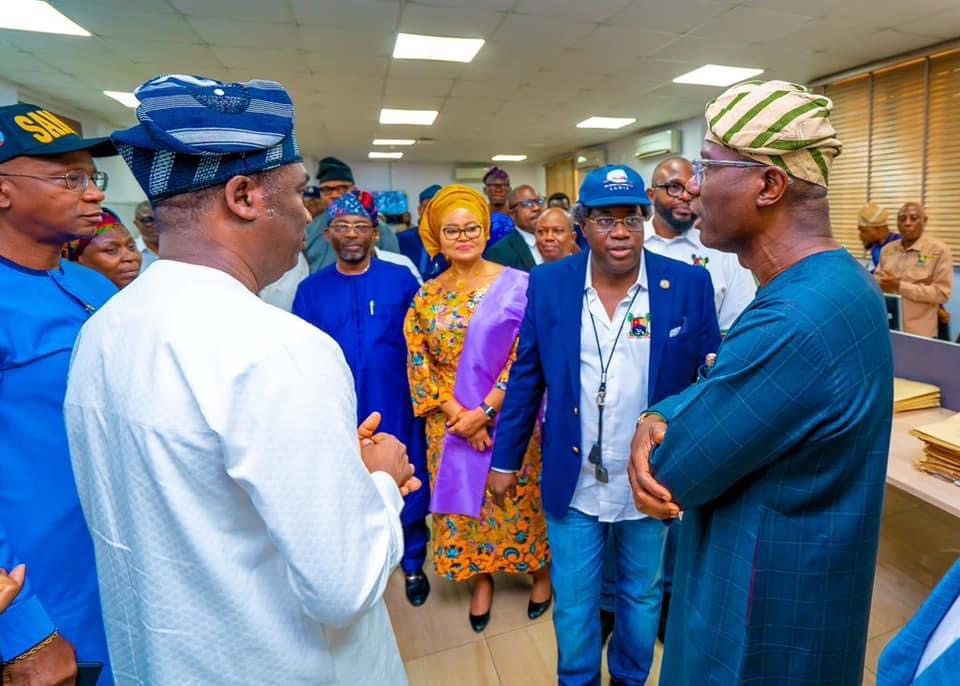
Launch of Lagos Carbon: Africa’s First Domestic Environmental Market
Governor Babajide Sanwo-Olu recently announced the launch ofLagos Carbon, marking a significant milestone as Africa’s first domestic environmental market. This initiative is designed to drive investments into decarbonisation and regenerative projects across the state, aiming to create a sustainable future for Lagos and beyond.
The announcement was made during the11th Lagos International Climate Change Summit (LICCS)held at the Lagos Continental Hotel in Victoria Island. Sanwo-Olu emphasized that Lagos Carbon will utilizeblockchain technologyto facilitate the trading ofInternationally Transferred Mitigation Outcomes (ITMOs)and support Nigeria’sNationally Determined Contribution (NDC)under the Paris Agreement.
This innovative approach allows countries and companies globally to finance verified emission reductions and removals within Lagos and across Nigeria. The initiative aims to drivegreen investment, job creation, technology transfer, and long-term prosperity. Sanwo-Olu highlighted that investing in Lagos’ resilience is not philanthropy but smart economics, emphasizing its role in stabilizing Africa’s most dynamic economy and securing the continent’s coastal future.
Aligning with Global Momentum
The governor stressed that the launch aligns with global momentum ahead ofCOP30in Brazil, showcasing Lagos’ readiness to lead in the global climate economy. He stated, “Lagos is leading Africa’s charge, showing that resilience is not a privilege of wealth but a product of will. If Lagos can rise from the tides, so can other African cities.”
Sanwo-Olu outlined Lagos’ climate response around three pillars —resilience, innovation, and financing— aimed at protecting lives and livelihoods while unlocking green and blue economic opportunities. He cited theGreat Wall of Lagos, one of Africa’s most ambitious coastal defense systems, which transformed erosion-threatened shores into the thrivingEko Atlantic City, as evidence of the state’s forward-looking environmental infrastructure.
Innovations in Urban Mobility
Through theOmi Èkó Initiative, Lagos is redefining urban mobility with a low-carbon water transport system powered by clean-energy ferries, solar docking hubs, and smart navigation technologies, in partnership with theFrench Development Agency (AFD)and theEuropean Investment Bank (EIB).
Additionally, the governor announced Lagos as the first African city to join theE1 Electric Boat Series— the world’s premier electric marine competition. This symbolic step reflects the state’s determination to “race toward the future, not wait for it.”
Resilience Beyond Infrastructure
Sanwo-Olu stressed that true resilience extends beyond infrastructure to harmony with nature. The state is gazettingwetland reserves and mangrove forestswhile introducing aWetlands Carbon Credit Frameworkto reward conservation efforts by local communities.
He referenced theLagos Climate Adaptation and Resilience Plan (LCARP)and theClimate Investment Opportunities Diagnostic (CIOD), developed with theInternational Finance Corporation (IFC), both serving as roadmaps aligning climate priorities with financing across clean energy, sustainable transport, and resilient infrastructure.
Urgency of Climate Leadership
Citing UN Secretary-General António Guterres’ warning that “the era of global boiling has arrived,” Sanwo-Olu said Africa cannot afford incremental steps. “The time for transformative climate leadership is now. The blue economy is not just an economic concept—it is a lifeline for the planet,” he declared.
Lagos State Commissioner for the Environment and Water Resources, Mr. Tokunbo Wahab, reaffirmed the state’s readiness to lead Africa’s transition toward a sustainableblue economy, stating that Lagos is transforming the climate crisis into opportunities for growth and innovation.
A New Era of Sustainable Financing
According to Wahab, the summit’s theme —“Blue Economy, Green Money: Financing Africa’s Coastal Resilience and Ocean Innovation”— underscores the urgency of mobilizing sustainable financing to protect coastal ecosystems and unlock prosperity. He added, “Where others see risk, Lagos sees opportunity. We have the chance to redefine our relationship with the ocean, not as a resource to exploit, but as a living system to nurture.”
Wahab announced the official launch of theClimate Investment Opportunities Diagnostic (CIOD)— a landmark policy linking environmental priorities with tangible investment pathways for a low-carbon future. Describing it as a bridge between ambition and financial action, he said the CIOD would guide public and private investors in identifying high-impact projects across clean energy, sustainable transport, and resilient infrastructure.
Circular Economy in Action
He further revealed that by December 2025, Lagos will commission abiogas facilityat theIkosi-Isheri Fruit Market, in partnership with theC40 Climate Global Leadership Group. The plant will convert 500 kilograms of fruit waste daily into clean energy to power market streetlights, provide cooking fuel, and charge electronic devices, while its by-products serve as organic fertilizer for farmers.
“This project embodies the circular economy we envision — where waste becomes wealth, energy drives productivity, and innovation powers inclusivity,” Wahab explained.
Collaboration for a Sustainable Future
Wahab added that Lagos’ environmental challenges mirror those of other African coastal cities, calling for continental collaboration in data sharing, technology exchange, and policy alignment. “Our challenges transcend borders. Lagos is ready — ready for investment, innovation, and to build resilience that benefits all our people,” he said.
Minister for Marine and Blue Economy, Mr. Gboyega Oyetola, represented by NIMASA Director-General Dr. Dayo Mobereola, reiterated the Federal Government’s commitment to strengthening maritime governance and promoting environmental sustainability. He said Lagos remains central to achieving Nigeria’s marine vision, with ongoing roadmaps focused on conservation, innovation, and sustainable use of ocean resources.
The Federal Government, he added, will continue to collaborate with public and private partners to unlock maritime potential, enhance sea security, and ensure long-term benefits for Nigeria’s economy and coastal communities.