
The Persistent Role of Tobacco in African Economies
Tobacco remains a vital component of many African economies, yet the continent continues to face significant public health challenges linked to tobacco use. This has created a complex conflict between economic reliance on tobacco and the urgent need to protect public health.
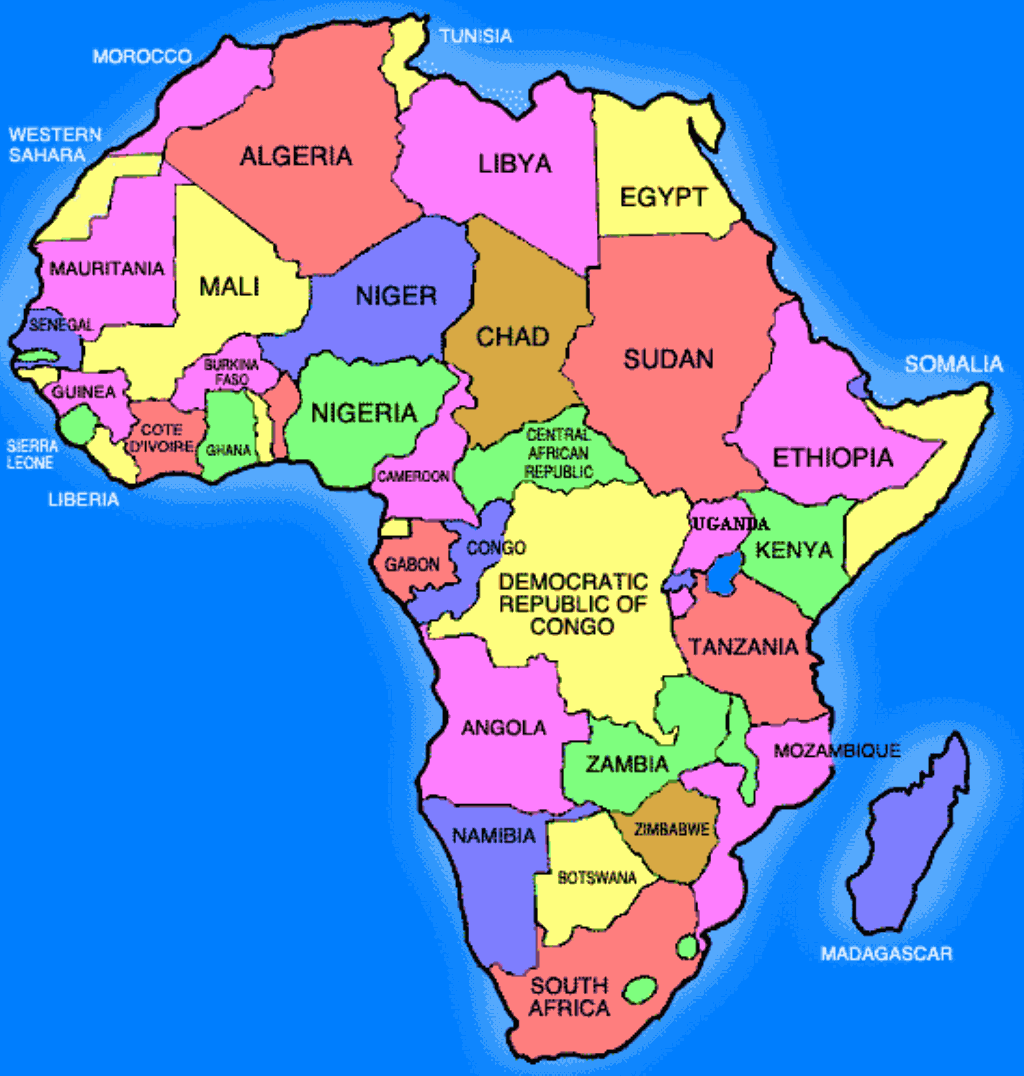
Zimbabwe is the largest producer of flue-cured tobacco in Africa, with its 2025 output reaching 355 million kilograms worth US$1.2 billion, according to Tobacco Reporter. For the 2025/26 farming season, the country had already registered about 82,000 growers by the end of October 2025, down from 126,000 during the previous season, as reported by the Tobacco Industry Marketing Board (TIMB).
Across the border in Malawi, another major tobacco producer, the country was projected to produce 175 million kilograms in 2025, representing a 31% increase from the 133 million kilograms recorded the previous year.
The Dilemma of Tobacco-Dependent Economies
Countries that rely heavily on tobacco as a major foreign currency earner and contributor to GDP often struggle to implement effective control measures and fair taxation policies. In some cases, novel nicotine products face higher taxes than cigarettes as a deterrent and to shield the traditional tobacco sector from emerging competition.
Sahan Lungu, a Tobacco Harm Reduction practitioner from Malawi, emphasized the difficulty of implementing effective tobacco control measures and taxes in Malawi. He noted that tobacco contributes over 60% of national export earnings, making it challenging to implement stringent tobacco control measures without risking economic instability. Smallholder farmers in Malawi often view tobacco farming as economically viable due to its profitability.
Poor coordination among the Ministries of Finance, Agriculture, and Health hinders the development of comprehensive Tobacco Harm Reduction strategies. A collaborative approach would enable more balanced policies that consider health, agriculture, and trade aspects.
Lungu highlighted that over 5,000 people die each year in Malawi from tobacco-related illnesses, and nearly a million people are daily tobacco users. While Malawi applies a 1% withholding tax on small-scale farmers’ sales to ease their financial burden, concerns remain about corporate tax evasion among major producers.
Joseph Magero, chairman of the Campaign for Safer Alternatives (CASA), stated that the tobacco industry is a sensitive sector for African economies. He noted that tobacco provides income and employment for millions, especially in rural areas of countries like Malawi, Zimbabwe, and Tanzania, where few alternative cash crops exist. However, farmers often remain trapped in cycles of poverty due to low farm-gate prices, debt to leaf-buying companies, and fluctuating global demand.
Taxation: The Double-Edged Sword of Tobacco Control
In Zimbabwe, excise taxes on tobacco products are used to fund health initiatives and fiscal reforms, indicating efforts to align taxation policies with public health objectives. A notable example was the reversal of a proposed 10% tax on tobacco farmers in 2017 following industry backlash, highlighting the challenge of balancing fiscal needs with industry interests.
South Africa, a signatory to the World Health Organisation Framework Convention on Tobacco Control (WHO-FCTC), has employed varying tax regimes to reduce tobacco use. Between 1994 and 2009, South Africa saw a sharp increase in excise taxes alongside stronger tobacco control laws, leading to a major decline in smoking rates and significant revenue gains.
Since then, South Africa has continued to raise tobacco taxes, with the government increasing excise duties above inflation levels. In the 2025 national budget, tobacco excise duties rose by 4.75%. As of the 2024/2025 financial year, the tax stands at approximately R21.77 per pack of 20 cigarettes.
Despite these efforts, smoking rates and deaths from tobacco-related diseases remain high. Data from the Global State of Tobacco Harm Reduction show that 20.3% of South African adults aged 15 and older smoked regularly in 2022, compared with 20.2% in 2020 and 20.7% in 2019. The country also recorded about 32,400 tobacco-related deaths, accounting for roughly 10% of total annual deaths.
Dr Mercy Korir, a Medical Doctor from Kenya, explained that over-taxation could work against intended public health outcomes. She noted that over-taxation often fuels smuggling and counterfeit markets, especially where enforcement is weak, undermining both health goals and government revenue.
The Rise of the Illicit Tobacco Market in Africa
The illicit tobacco industry has grown into a multibillion-dollar enterprise. Estimates from The Tobacco Atlas and Philip Morris International (PMI) put the global illicit tobacco market at between US$40 billion and US$50 billion annually, representing 11–15% of the worldwide market. Evidence shows that where taxes and regulatory restrictions are particularly heavy, the illicit market tends to expand rapidly.
In South Africa, the illicit tobacco trade was estimated to cost the economy around ZAR20 billion in 2023. The South Africa Tobacco Transformation Alliance reports that approximately 37 billion cigarettes are smoked in the country annually, with a large share believed to be illicit.
Francois van der Merwe, spokesperson for the South Africa Tobacco Transformation Alliance, described the situation as a “national disaster.” He emphasized that when 70% of a major sector like tobacco is illicit, it signals a serious crisis.
Meanwhile, the South African Parliament is currently debating the Tobacco Products and Electronic Delivery Systems Bill, which seeks to tighten regulations around both traditional and emerging nicotine products.
Magero warned that excessive taxes often drive consumers into the black market. He noted that when consumers turn to the black market, governments lose revenue, oversight vanishes, and people are exposed to unregulated products with no safety standards or quality controls.
In Kenya, the government has proposed the Tobacco Control Amendment Bill, which seeks to amend the Tobacco Control Act (Cap. 245A of 2007) to regulate both traditional tobacco products and newer nicotine-delivery systems such as e-cigarettes and nicotine pouches.