

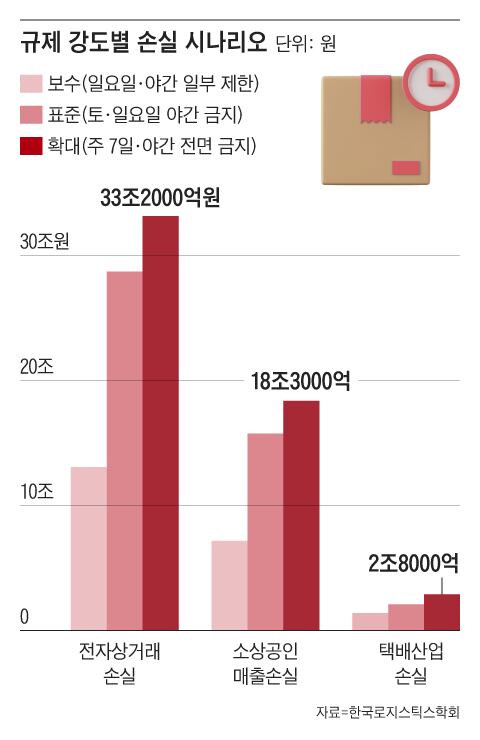
The potential ban on dawn delivery and seven-day-a-week delivery services could lead to significant economic losses for e-commerce companies, the delivery industry, and other related sectors. According to a report by the Korea Logistics Society, a leading academic organization in the logistics sector, such a ban could result in annual losses of approximately 54.3 trillion Korean won. The report, titled “Research on the Ripple Effects of Dawn Delivery and Seven-Day-A-Week Delivery,” highlights that if these services are suspended, leading to a 40% drop in parcel orders, the financial impact would be substantial.
E-commerce giants like Coupang could face a sales decline of 33.2 trillion Korean won, while small businesses might experience a revenue loss of 18.3 trillion Korean won. The delivery industry itself is expected to suffer around 2.8 trillion Korean won in losses due to job reductions and operational challenges. These figures underscore the critical role that these delivery services play in sustaining the current economic structure.
The research team analyzed the broader economic impacts of dawn and seven-day-a-week delivery services. Their findings revealed a total economic impact of 5.8 trillion Korean won. This includes 1.54 trillion Korean won in final demand, 2.72 trillion Korean won in production-induced value, 1.25 trillion Korean won in value-added effects, and 300 billion Korean won in import-induced value. Additionally, the services have contributed to the creation of 12,000 jobs and generated 7,000 employment opportunities.
The report emphasizes the growth of the dawn delivery market, which expanded from 400 billion Korean won in 2015 to 11.8 trillion Korean won in 2024. This growth has led to significant job creation and has positively influenced urban traffic congestion reduction, air quality improvement, and overall urban environment enhancement. It has also provided small businesses with expanded sales channels, enabling them to sell products that are otherwise difficult to market without fast delivery.
Moreover, the report states that higher online sales ratios driven by dawn and seven-day-a-week delivery services have had a positive effect on regional industry revenues and employment. These services allow small businesses to access diverse, high-frequency, small-scale sales channels and facilitate the sale of products that require rapid delivery.
The Korea Logistics Society stresses the importance of managing these delivery services to ensure fair labor compensation, guaranteed rest days, and safe working conditions. They argue that regulating these services could reduce service quality, efficiency, and competitiveness.
Earlier, the National Delivery Workers’ Union under the Korean Confederation of Trade Unions proposed at a meeting of the ‘Social Dialogue Organization for Delivery Services’—launched on the 22nd of last month under the leadership of the Democratic Party of Korea—to ban dawn delivery services between midnight and 5 a.m. to prevent overwork. However, some delivery workers opposed this proposal, arguing that such restrictions could disrupt operations and harm employment stability.
The Coupang Partners Union, representing 10,000 contracted delivery workers for Coupang, the market leader in dawn delivery, expressed strong opposition to the proposed ban. In a statement released on the 3rd, they claimed that layoffs are “murder” and accused the union of trying to fire night delivery workers. The union also shared survey results from 2,045 dawn delivery workers, revealing that 93% opposed restrictions on dawn delivery.
Additionally, the Coupang Labor Union criticized the Korean Confederation of Trade Unions’ push to ban dawn delivery in a statement on the 7th, calling it “retaliation for the union’s withdrawal from the Korean Confederation of Trade Unions.” The Coupang Labor Union added, “The Korean Confederation of Trade Unions claims dawn delivery bans are essential for workers, but they never made such arguments when the Coupang Labor Union was affiliated. It is absurd for a labor union to advocate for policies that take away members’ jobs.” The Coupang Labor Union had withdrawn from the Korean Confederation of Trade Unions in November 2023 with 93% approval from its members.