
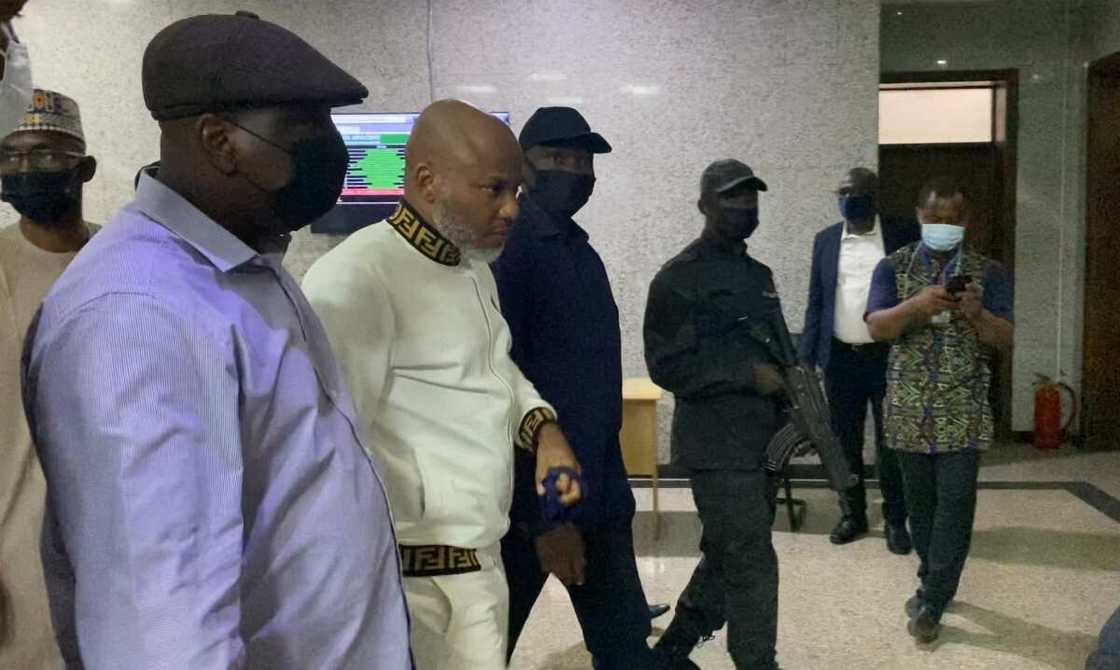
Court Sets November 20 for Judgment in Terrorism Case Involving IPOB Leader
The Federal High Court in Abuja has scheduled November 20 as the date for delivering its judgment in a terrorism case involving Nnamdi Kanu, the detained leader of the proscribed Indigenous People of Biafra (IPOB). The decision was announced by Justice James Omotosho on Friday, following Kanu’s failure to present his defense within the six-day period granted by the court.
Justice Omotosho emphasized that Kanu had been provided with ample time and opportunities to defend himself. However, he chose not to take advantage of these provisions. The judge stated that Kanu cannot now argue that his constitutional right to a fair hearing was violated, given his refusal to utilize the window of opportunity offered by the court.
Kanu is currently facing terrorism-related charges brought by the Federal Government. Authorities have accused him of inciting violence and contributing to national instability through his activities with IPOB. The case has drawn significant attention due to the political and social implications surrounding IPOB and its activities.
Background of the Case
Nnamdi Kanu, a prominent figure in the movement advocating for the independence of the former Republic of Biafra, has been in detention for several years. His arrest and subsequent legal proceedings have sparked debates about the balance between national security and individual rights. The charges against him are part of a broader effort by the government to address what it perceives as threats to national unity and stability.
The court’s decision to set a specific date for judgment highlights the procedural steps taken in such high-profile cases. It also underscores the importance of adhering to legal timelines and ensuring that all parties involved have the necessary time to prepare their arguments.
Legal Implications and Public Reaction
The ruling by Justice Omotosho has generated mixed reactions from the public and legal experts. Some view it as a necessary step to ensure the rule of law and prevent prolonged detentions without proper judicial review. Others, however, express concerns about the potential for bias or overreach in the legal process.
Legal analysts suggest that the outcome of this case could have far-reaching implications for similar cases involving political activists and leaders of banned organizations. It may also influence how courts handle matters related to national security and the rights of individuals accused of serious offenses.
Ongoing Developments
As the court prepares for the judgment on November 20, further details about the case are expected to emerge. This includes the presentation of evidence, witness testimonies, and any additional arguments from both the prosecution and the defense. The proceedings will be closely monitored by media outlets, legal professionals, and members of the public who are interested in the case.