
Addressing the Passport Crisis in Nepal
Nepal is currently navigating a critical situation involving its passport supply, with the government taking urgent steps to prevent a potential crisis. The Department of Passports (DoP) has reported that current stock levels will only meet demand until December, prompting immediate negotiations with both German and French companies to secure additional supplies.
Prime Minister Sushila Karki has been actively involved in these discussions, engaging with ministers, government officials, and representatives from IDEMIA, the company that supplied passports to Nepal from 2010 until last August. Tirtha Raj Aryal, director general at the DoP, confirmed that proposals have been received and are under discussion, though specific details remain undisclosed.
Current Stock and Future Deliveries
The current stock of passports is expected to last through December, but two German firms are scheduled to deliver new batches only after mid-March 2026. To bridge this gap, the prime minister has initiated consultations with officials and vendors who are willing to provide temporary solutions.
Veridos, a German firm, recently submitted a commercial proposal to the DoP. Additionally, the department has requested IDEMIA to continue supplying passports for the interim period. During a recent meeting with Prime Minister Karki, IDEMIA representatives assured the government of their readiness to supply passports at the same price as before.
Negotiations with IDEMIA
Despite initial challenges, IDEMIA’s local representatives have expressed willingness to meet the stopgap requirement at the same rate. This has led to high-level discussions, with the group CEO of IDEMIA, Antoine Grenier, and his global sales director set to visit Kathmandu on Friday.
“If talks go well, a new agreement to purchase between 200,000 and 500,000 passports will be reached,” according to a Nepali official privy to the matter.
Under the original agreement, IDEMIA supplied passports at $10.30 per copy, which included system installation, data storage, and personalisation facilities. The government is now seeking a similar price arrangement with IDEMIA.
Previous Challenges and Current Status
Earlier, DoP officials had claimed that IDEMIA quoted an excessive price during previous negotiations, leading to a halt in talks. The government even sent its ambassador to France, Sudhir Bhattarai, to request additional passports, but this effort did not yield results.
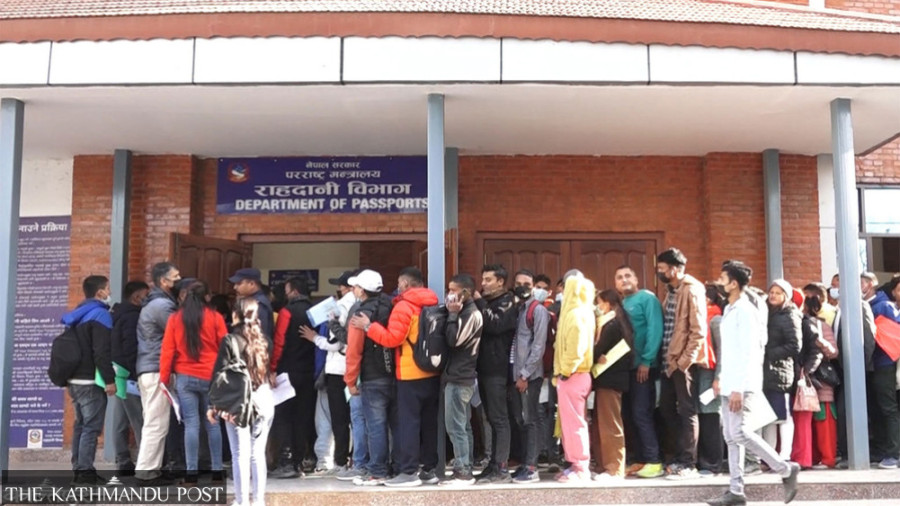
Currently, the DoP has approximately 200,000 passports, including ordinary, diplomatic, officials, and seamen categories, which may not last beyond December at the current rate of demand. In response, the DoP issued a notice limiting applications to 1,000 per day, a significant drop from the usual 6,000 applications.
Alternative Proposals and Technical Considerations
Veridos has also offered to supply Machine-Readable Passports (MRPs) to address the stopgap shortage. This was discussed with the German ambassador, Udo Volz, last week. Veridos has submitted a commercial proposal, stating it is open to negotiations. The proposal suggests that Veridos can use the system and encrypted data held by IDEMIA, which would avoid the cost of installing a new system.
According to an official familiar with the proposal, “Veridos has offered to provide MRPs at the cost of US $8.5 per copy. Likewise, Veridos has stated that costs could drop if IDEMIA provides the system and data.”
Aryal agrees that it is better if IDEMIA supplies the additional passports due to the complex technical transfers required if the job goes to the German firm.
Transition to Biometric Passports
Nepal transitioned from MRPs to biometric passports in 2022. After efforts to procure 300,000 biometric passports from IDEMIA stalled, the Ministry of Foreign Affairs and the DoP started negotiations with German firms to either deliver passports earlier than mid-March or print MRPs to cover the shortage from December to mid-March.
If deals with German and French firms fail, passport supply may have to be further reduced until March or until Veridos begins deliveries. However, Prime Minister Karki and government officials are keen to avoid complications.
Government Commitment
“Today, I received an update from the officials of the Ministry of Foreign Affairs and the Department of Passports regarding the status of passport distribution,” Karki wrote on X on Tuesday. “After meeting with ministers and officials, the government is fully committed to ensuring that citizens do not face any difficulties in obtaining their passports.”
“The government is continuously working to ensure smooth and timely passport distribution according to demand, and effective measures will be taken soon to resolve the issue,” she added.
The prime minister’s chief adviser, Ajaya Bhadra Khanal, said the government will come to an agreement on passports within a few days.
Importance of Passport Supply
With a large number of people applying for passports, especially youths going abroad for jobs and higher education, as well as those renewing existing ones, Nepal cannot afford to stop passport distribution even for a day.
Nepal began issuing e-passports on November 17, 2021. MRPs replaced handwritten passports in 2010. The International Civil Aviation Organisation still recognises MRPs. When Nepal first launched MRPs, the French firm Oberthur Technologies had won the bid. Later, Oberthur Technology was taken over by IDEMIA.