
Moldova’s Path to EU Membership: A Strategic and Political Challenge
President Maia Sandu of Moldova has emphasized the need for the European Union to adopt “creative” approaches to overcome political stalemates and accelerate the process of Moldova joining the bloc. As a leader who secured a second term in office through a September election, Sandu has consistently advocated for a pro-European agenda, making EU membership a top priority for her nation.
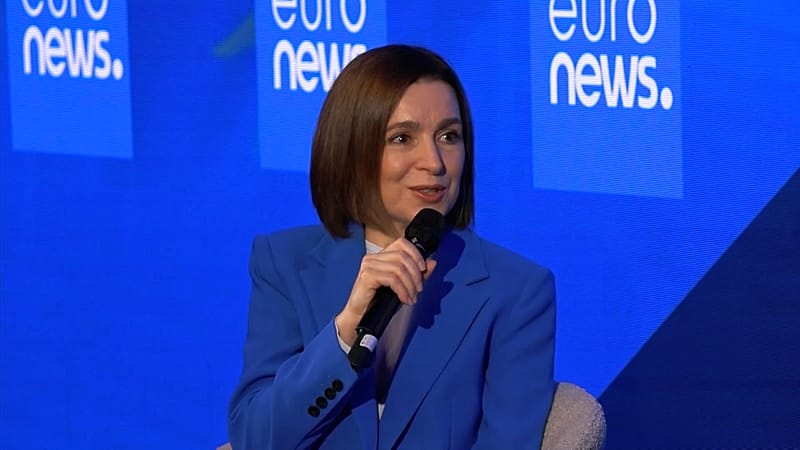
Moldova, home to approximately 2.4 million people, views EU accession as a crucial safeguard for its independence. The country’s recent election drew significant international attention, highlighting the broader geopolitical tension between the West and Russia. Sandu underscored this point during an interview with The Europe Conversation at an EU enlargement summit hosted by Euronews in Brussels.
“You cannot allow our countries to be used by authoritarian regimes, because that is exactly what is going to happen if we are not part of the European Union,” she said. “This is vital.”
EU Membership Process and Reform Efforts
Moldova submitted its application for EU membership in 2022 and was granted candidate status alongside Ukraine in June of that year. Both nations are now working to open what are known as “clusters”—a set of requirements necessary to advance the accession negotiations. However, all 27 EU member states must unanimously agree that these conditions have been met before moving forward with the next phase of negotiations.
The European Commission recently released a report commending Moldova’s pace of reforms aimed at aligning with EU standards. It recommended opening three clusters for negotiations immediately and three more before the end of the year. The report also acknowledged the challenges Moldova faced, including “unprecedented Russian interference” ahead of the September election.
Despite these positive developments, Moldova remains in a delicate position, navigating complex political dynamics within the EU.
The Hungarian Veto and Geopolitical Ties
Moldova’s candidacy is closely linked to that of Ukraine, despite the EU’s merit-based approach to membership applications. While each country is evaluated individually, the EU has hesitated to progress Moldova’s bid without addressing Ukraine’s situation. This is due to the geographical and strategic interdependence between the two nations.
Ukraine has expressed concerns that separating the two countries would send a negative signal. It also noted that it applied for membership before Moldova. However, Ukraine’s own path to EU membership is stalled due to the veto from Hungary’s Prime Minister Viktor Orbán, who opposes Ukraine’s accession and prefers a “strategic partnership” instead.
Sandu addressed the issue of EU rules during an interview with Euronews, stating that while she supports the merit-based criteria, the EU must find political solutions to break the impasse around unanimity and the veto policy. She emphasized that beyond completing technical chapters in negotiations with the Commission, all 27 EU leaders must agree unanimously before a candidate can join as a full member.
“I know it’s not easy, but I do think that the EU should get a bit creative with its own internal reforms, because it is also in its interest,” she said. “From our side, we are working hard to meet EU standards, and this should be recognised.”
Future Goals and EU Leadership
Moldova aims to complete its accession negotiations by 2028, a goal described by the European Commission as “ambitious, but achievable.” The head of the European Council, António Costa, has urged EU leaders to maintain momentum on enlargement efforts, warning that failure to do so could result in being “trapped by painful historical legacies.”