
Regional Disparities in Obesity Rates Across South Korea
A man in his 70s from the provinces recently visited a hospital due to knee pain and was told by a doctor, “The impact on your knees is due to obesity. You need to lose weight.” He said, “I thought I was around average for my age group, so it was really unexpected,” adding, “I never realized I was obese until now.”
This experience highlights a growing concern in South Korea, where one in three adults is classified as obese. The trend shows that regions with lower income and a higher proportion of elderly residents tend to have higher obesity rates.
Obesity Statistics and Trends
According to an analysis by the Korea Disease Control and Prevention Agency based on the ‘2024 Community Health Survey,’ 34.4% of South Korean adults have a body mass index (BMI) of 25 or higher, which is medically classified as obese. BMI is calculated by dividing weight in kilograms by the square of height in meters. While South Korea’s obesity rate is lower than the OECD average of 56.4%, it has been rising steadily due to increasingly Westernized diets. In 2015, the obesity rate was 26.3%, meaning one in four adults, but it has increased by 1.3 times over nine years.
Regional Variations in Obesity Rates
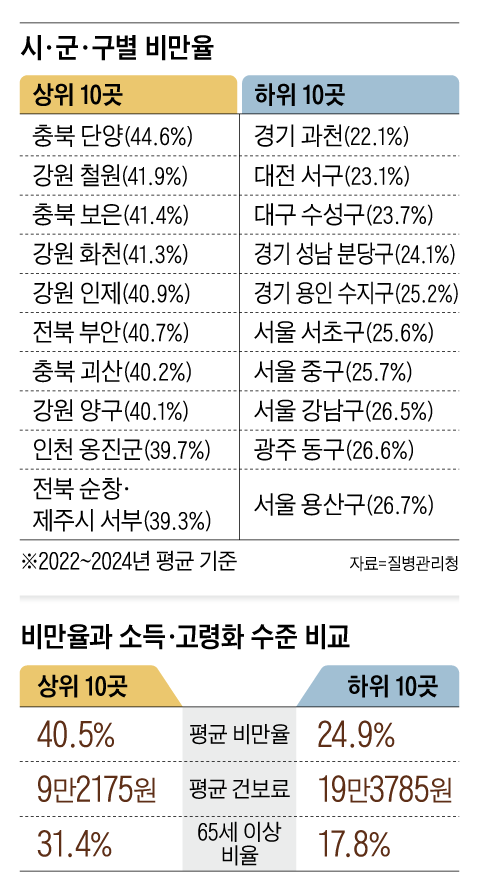
Gwacheon City, Gyeonggi Province, had the lowest average obesity rate over three years (2022–2024), at 22.1%. This was followed by Seo-gu, Daejeon, 23.1%; Suseong-gu, Daegu, 23.7%; Bundang-gu, Seongnam City, Gyeonggi Province, 24.1%; and Suji-gu, Yongin City, Gyeonggi Province, 25.2%. These areas are characterized by high income levels and relatively fewer elderly residents. In Gwacheon City, the average health insurance premium per household, an indicator of income level, was 212,429 Korean won as of 2024, 65% higher than the national average (128,276 Korean won). The average proportion of the population aged 65 and over was 15.1%, lower than the national average (19.5%).
In contrast, regions with high obesity rates had relatively lower incomes and higher proportions of elderly residents. Danyang County, North Chungcheong Province, had the highest obesity rate nationwide at 44.6%. This was followed by Cheorwon County, Gangwon Province, 41.9%; Boeun County, North Chungcheong Province, 41.4%; Hwacheon County, Gangwon Province, 41.3%; and Inje County, Gangwon Province, 40.9%. In Danyang County, the average health insurance premium was only 90,060 Korean won, and the proportion of residents aged 65 and over was 37.6%.
Income, Age, and Obesity
The average health insurance premium per household in the bottom 10 regions with low obesity rates (average obesity rate 24.9%) was 193,785 Korean won. In contrast, the premium in the top 10 regions with high obesity rates (average obesity rate 40.5%) was 92,175 Korean won, a difference of over 100,000 Korean won. The average proportion of the population aged 65 and over was also different, at 17.8% (average for the bottom 10) and 31.4% (average for the top 10).
Professor Kim Min-sun, director of the Korean Society for the Study of Obesity and a professor at Asan Medical Center’s Department of Endocrinology, stated, “People with higher income and younger age are more concerned about health and more likely to seek out healthy foods,” adding, “The difference in income and age leads to regional disparities in obesity.”
Public Transportation and Lifestyle Factors
Another characteristic of regions with high obesity rates is underdeveloped public transportation. Professor Oh Sang-woo from Dongguk University’s Department of Family Medicine said, “In areas with developed public transportation, people walk at least to the station, but in areas without such infrastructure, people rely mostly on cars, which contributes to higher obesity rates.”
Health Implications of Obesity
Obesity is not just a cosmetic issue; it is the starting point for other diseases. Obese individuals have up to twice the risk of cardiovascular diseases, and their likelihood of developing diabetes or cancer also increases. This is why there are calls within the medical community to “view obesity as a more serious disease and for the government to manage it more proactively.”
Gender and Age Differences
By gender, men (41.4%) were more likely to be obese than women (23%). Men in their 30s (53.1%) and 40s (50.3%), who are active in social life, had high obesity rates, while women in their 60s (26.6%) and 70s (27.9%) had relatively higher rates. The survey also found that 77.8% of obese men and 89.8% of obese women were aware of their obesity. Additionally, 74.7% of obese men and 78.4% of obese women were attempting to control their weight.