Unusual Trajectory of 3I/ATLAS
On July 1, 2025, a comet was discovered that does not follow a classical orbit around the Sun. Instead, it follows a hyperbolic trajectory, which suggests that it may originate from beyond our solar system. This unusual behavior has drawn significant attention from scientists.
An Interstellar Visitor
The comet, known as 3I/ATLAS, is now at the center of scientific debate. Its movements are being closely observed, including its recent non-gravitational acceleration. Scientists are particularly interested in understanding what causes this anomaly, as it deviates from typical comet behavior.
Non-Gravitational Acceleration Detected
What makes 3I/ATLAS especially intriguing is its atypical orbital behavior. Its trajectory reveals an acceleration that exceeds what gravitational attraction alone could produce. This suggests that an additional mechanism is influencing its motion. However, the exact nature of this mechanism remains unexplained by the scientific community.
In normal comets, such anomalies are often caused by jets of gas from evaporating ice. However, in this case, the effect seems much more intense than usual, leaving scientists puzzled. Recent studies have focused on the gas clouds observed around the comet and the associated visual changes.
Material Emission and Observations
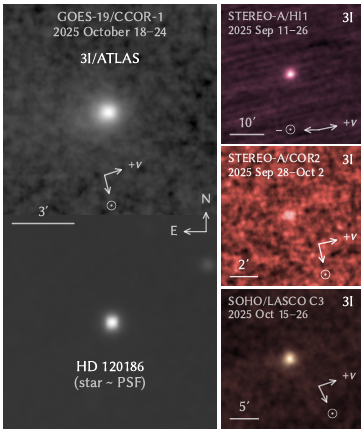
These investigations led to an article published last week in arXiv, an open-access repository for scientific prepublications. The article titledRapid Brightening of 3I/ATLAS Ahead of Perihelionby Qicheng Zhang and Karl Battams questions the appearance of brightness just before perihelion. Perihelion refers to the point on the comet’s trajectory closest to the Sun.
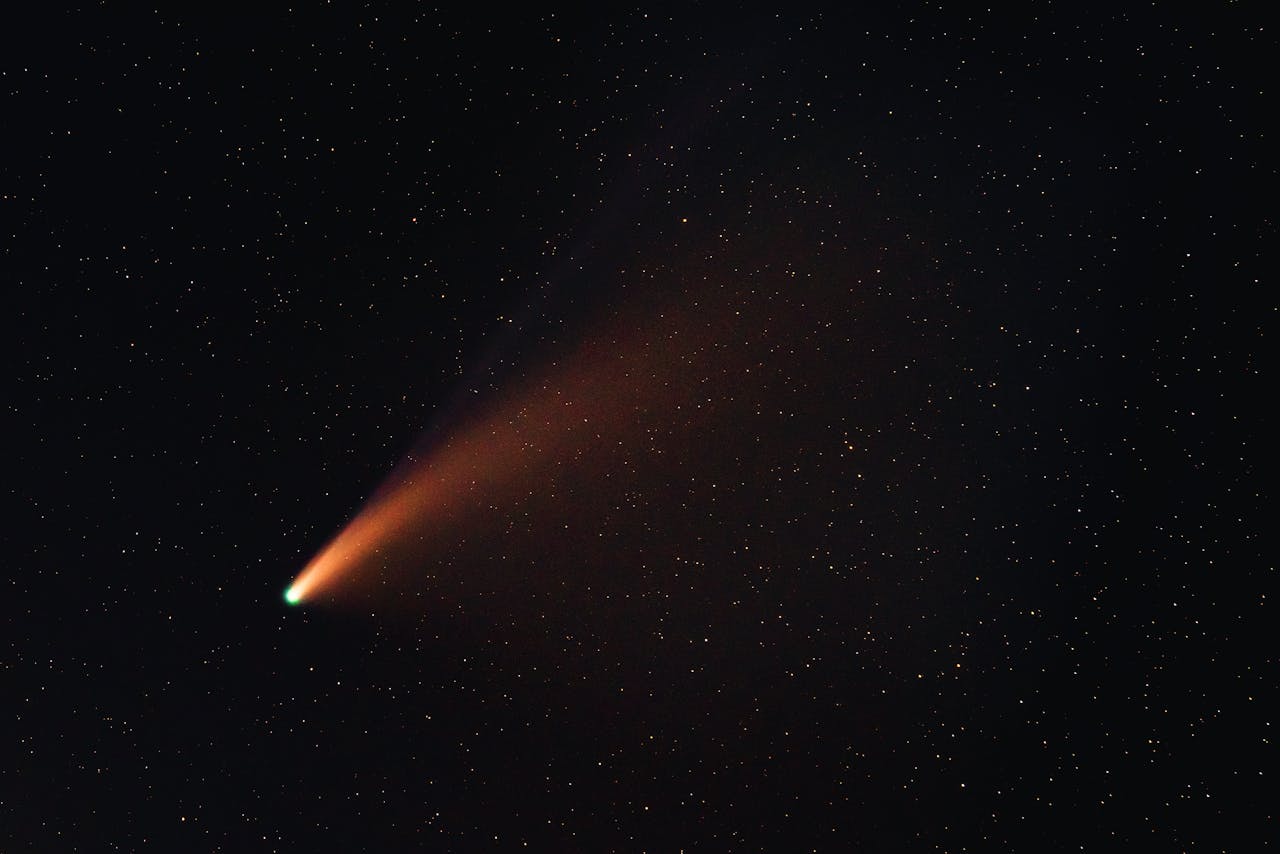
3I/ATLAS has a coma or tail that doesn’t quite resemble what is typically seen in comets approaching the Sun. Additionally, a bluer hue was observed at perihelion. This supports the hypothesis of material emission, such as ice or gas, which could act like a natural “rocket,” provoking a thrust that slightly modifies the trajectory.
Controversial Hypotheses
Several hypotheses are currently under discussion within the scientific community. One suggests that the comet’s acceleration is due to outgassing of matter, but in unusual proportions or conditions. Another, more speculative, hypothesis proposes that the non-gravitational acceleration could be the result of an internal or artificial mechanism present within the comet—some even suggest the possibility of an engine.
This second idea is supported by the comet’s unusual color and trajectory. However, it is important to note that this interpretation remains highly speculative and is more of a conjecture than scientific proof at this stage.
Avi Loeb, a physicist at Harvard University, emphasizes the importance of observing the comet’s size after its passage behind the Sun. If its diameter remains unchanged, this could raise new questions due to the thermal effects likely to alter its structure.
Scientific Advances and Significance
According to scientists, 3I/ATLAS is an exceptional interstellar object that could hold essential keys to understanding the formation of solar systems and the cosmic travelers that wander between the stars. Avi Loeb highlights that its passage through our solar system represents an unprecedented opportunity to directly analyze matter from elsewhere.
The challenge becomes even more fascinating if its enigmatic characteristics are evidence of a totally new phenomenon, one that could revolutionize our understanding of celestial objects. These multiple anomalies challenge established theories and force us to reconsider the extent of our knowledge.