
Government Measures and Their Impact on the Real Estate Market
The government introduced a series of measures on October 15 aimed at curbing the rapid rise in property prices, designating the entire Seoul metropolitan area and 12 regions in Gyeonggi Province as land transaction permit zones. However, despite these efforts, the real estate market has shown signs of heat spreading to areas outside of the regulated zones. This has led to an increase in apartment sales transactions and prices in non-regulated areas.
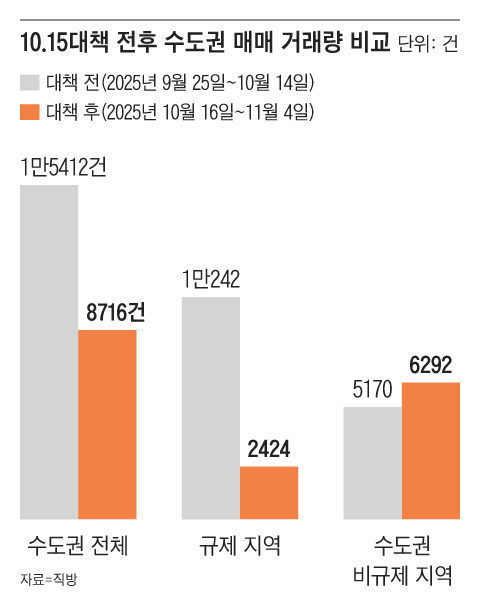
According to an analysis conducted by the real estate platform Zigbang using data from the Ministry of Land, Infrastructure and Transport, sales transactions in the regulated areas—comprising Seoul and the 12 designated regions in Gyeonggi Province—dropped significantly. During the 20 days following the implementation of the October 15 measures (October 16–November 4), there were 2,424 transactions, a decrease of 76% compared to the 10,024 transactions recorded in the 20 days prior (September 25–October 14). In contrast, transactions in non-regulated areas of the capital region increased by 22%, rising from 5,170 cases before the measures to 6,292 cases afterward. This shift in demand can be attributed to the lighter loan regulations and tax burdens in these areas.
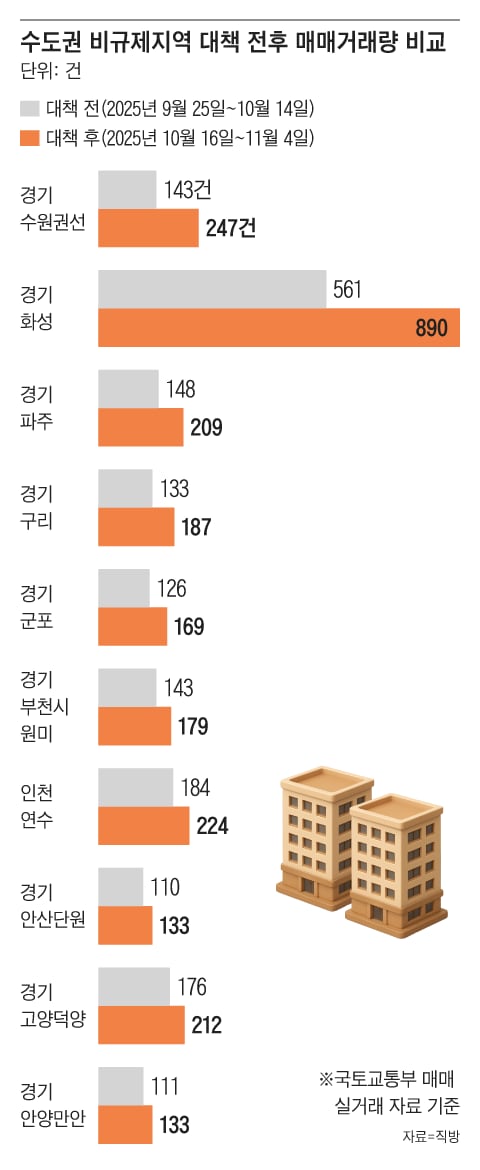
One of the areas that saw the most significant increase in transactions was Gwonseon-gu in Suwon City. Sales in this district surged by 73%, from 143 to 247 cases. Although parts of Suwon, such as Jang’an-gu, Paldal-gu, and Yeongtong-gu, were designated as regulated zones, Gwonseon-gu remained outside of the restrictions. Prices in the area have also risen. For instance, a 123㎡ unit at Gwonseon Jai e-Pyeonhansesang in Gwonseon-dong, which was priced in the mid-to-late 600 million Korean won range before the regulations, was sold for 700 million won on November 7 and now has a highest asking price of 850 million won.
Regional Transaction Trends
Hwaseong City emerged as the region with the highest transaction volume, with sales increasing from 561 cases before the measures to 890 cases afterward. The surge in activity is largely due to gap investment demand, particularly in Dongtan New City, which has seen a boost in transactions for large apartment complexes. Similarly, Paju and Guri Cities in Gyeonggi Province experienced a 41% increase in sales, while Gunpo City saw a 34% rise. Wonmi-gu in Bucheon City and Incheon also reported increases of 25%.
In contrast, the regulated areas witnessed a sharp decline in transaction volumes. Yeongdeungpo-gu in Seoul saw a 95% drop, while Sujeong-gu in Seongnam City and Seongdong-gu in Seoul both experienced declines of 93% and 91%, respectively. Bundang-gu in Gyeonggi Province also saw a significant decrease of 89%. Among previously regulated areas in the Gangnam region of Seoul, the impact was relatively less severe. Notably, Seocho-gu even recorded a 2% increase in transactions compared to pre-measure levels. Zigbang noted that “areas already under regulation were less affected by partial adjustments like loan limits.”
Conclusion
The recent measures implemented by the government have had a mixed impact on the real estate market. While they succeeded in curbing transactions in regulated areas, the shift in demand has led to increased activity in non-regulated regions. This trend highlights the complexities of managing a rapidly evolving real estate landscape and underscores the need for continued monitoring and potential policy adjustments.