
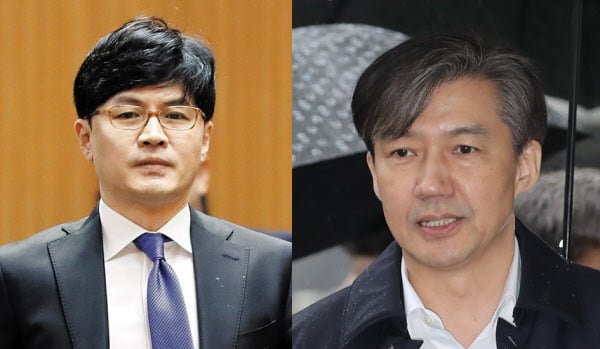
A Clash Over Legal Interpretations in the Daejang-dong Corruption Case
A recent public debate between former People Power Party leader Han Dong-hoon and Cho Kuk, interim leader of the Rebuilding Korea Party, has highlighted a significant legal dispute surrounding the recovery of damages from the Daejang-dong development corruption case. The disagreement centers on whether the state can confiscate or collect proceeds from the case, based on specific provisions of the Act on the Confiscation of Corruption Proceeds.
Cho Kuk’s Argument: State Cannot Confiscate Proceeds
Cho Kuk, referencing a Facebook post, mentioned that Seongnam City had announced a civil lawsuit seeking 489.5 billion won in damages against the Daejang-dong group. He argued that this case is one where the state cannot confiscate or collect proceeds. According to Cho, since the victim in this case is not the state but Seongnam City (specifically the Seongnam Urban Development Corporation), the conditions for confiscation or collection are not met unless Seongnam City cannot file a civil lawsuit.
He further explained that because Seongnam City has already filed a civil lawsuit and plans to increase the damages after the prosecution abandoned its appeal, the state cannot proceed with confiscation or collection. Cho suggested that the prosecution’s decision might affect the damage calculation in the civil lawsuit, but emphasized that the state is unable to take action in this case.
Han Dong-hoon’s Counterargument: Court Ruling Supports Confiscation
In response, Han Dong-hoon cited the first-instance ruling in the Daejang-dong case, stating that even if the Seongnam Urban Development Corporation has filed a civil lawsuit, the court has determined that this falls under the category of “cases where recovery of damages is recognized as severely difficult” as per the Act on the Confiscation of Corruption Proceeds.
The 22nd Criminal Division of the Seoul Central District Court, led by Presiding Judge Jo Hye-woo, noted that the first hearing for the civil lawsuit filed by the Seongnam Urban Development Corporation against the Daejang-dong group had not been properly held. The court stated that the measures for damage recovery, such as the exercise of the victim’s right to claim property return or damages, appear to be in a severely difficult state. Therefore, there is a significant need to promote swift damage recovery by having the state intervene in the damage recovery process, even belatedly, to collect the criminal proceeds and then return them to the victim.
Contradictions in Legal Interpretations
Han Dong-hoon pointed out that Cho Kuk’s argument contradicts the court’s ruling. He noted that while Cho cited the provision stating that “confiscation or collection is possible when recovery of damages is recognized as severely difficult,” he also insisted that “confiscation or collection is only possible if Seongnam City cannot file a civil lawsuit.” This, according to Han, represents two completely different statements.
He added, “Cho Kuk may not have seen the ruling, or even if he did, he might not have understood it, but those are two completely different statements.” Han emphasized that the ruling clearly states that the conditions for confiscation or collection are met in this case.
Implications of the Debate
This ongoing debate underscores the complexities involved in the legal procedures surrounding the Daejang-dong corruption case. It highlights the importance of understanding the nuances of the Act on the Confiscation of Corruption Proceeds and the role of the court in determining the appropriate course of action for recovering damages.
As the case continues to unfold, the interpretations provided by both Han Dong-hoon and Cho Kuk will likely influence public perception and future legal strategies in similar cases. The outcome of this debate could set a precedent for how similar corruption cases are handled in the future.