
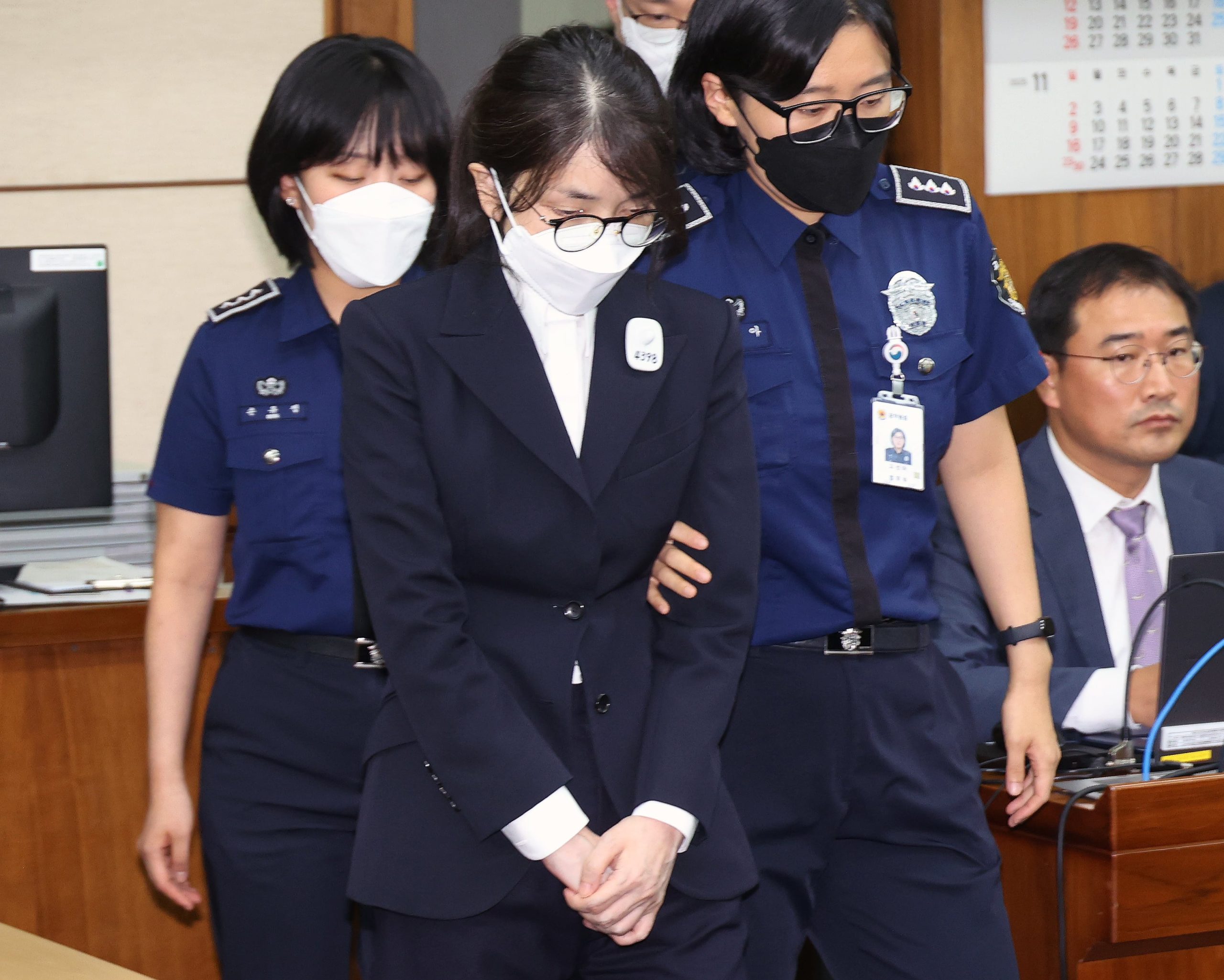
Legal Proceedings Against Former First Lady Kim Keon-hee
The case involving additional charges against former first lady Kim Keon-hee, related to allegations of Unification Church members’ collective enrollment in the People Power Party, has been assigned to the 27th Criminal Division of the Seoul Central District Court. The division is presided over by Judge Woo In-sung.
According to legal sources, the Seoul Central District Court allocated the case of Kim Keon-hee, along with other individuals including Unification Church leader Han Hak-ja, former global head Yun Young-ho, former chief secretary to the president Jeong Yoon-joo, and shaman Jeon Seong-bae—widely known as Geonjin—to the 27th Criminal Division. These individuals are facing additional charges of violating the Political Parties Act.
This division is already handling Kim’s case involving allegations of violating the Capital Markets Act. In addition, it is overseeing most of the cases related to collusion between religion and politics prosecuted by the special counsel team investigating former first lady Kim Keon-hee. This includes the Political Funds Act violation case involving People Power Party Representative Kweon Seong-dong and Han Hak-ja.
Additional Charges Against the Unification Church
The special counsel team previously announced that the Unification Church had been additionally charged with allegedly mobilizing church members to join the People Power Party en masse ahead of the party’s March 2023 national convention to support a specific candidate.
Investigations revealed that Kim requested Yun Young-ho, the former global head, in November 2022 through Jeon Seong-bae to organize the collective enrollment of church members. The scheme allegedly involved Kim colluding with Jeon to promise government-level support and proportional representation candidacy in the general election to the Unification Church in exchange for the church members’ enrollment. The goal was to secure the election of a candidate supporting former President Yoon Suk-yeol.
Key Individuals Involved
Han Hak-ja, Yun Young-ho, and Jeong Yoon-joo are accused of conspiring to forcibly enroll church members under this plan. The allegations suggest a coordinated effort between religious and political entities to influence the outcome of the election. This case highlights the complex relationship between religious organizations and political parties in South Korea.
Ongoing Investigations and Implications
The ongoing investigations into these allegations have raised concerns about the potential misuse of religious networks for political gain. The involvement of high-profile figures such as Kim Keon-hee and the Unification Church adds a layer of complexity to the case. It also underscores the need for transparency and accountability in political activities involving religious groups.
The 27th Criminal Division is expected to handle these cases with due diligence, ensuring that all parties involved are held accountable for their actions. The court’s role in this matter is crucial in maintaining public trust in the judicial system and upholding the rule of law.
Conclusion
The case involving Kim Keon-hee and the Unification Church represents a significant moment in South Korean legal and political history. The charges brought against these individuals highlight the potential for abuse of power and the importance of ethical conduct in both religious and political spheres. As the legal proceedings continue, the outcome of this case will likely have far-reaching implications for the relationship between religion and politics in the country.