
President Ruto’s Criticism of Sudan’s Warring Factions
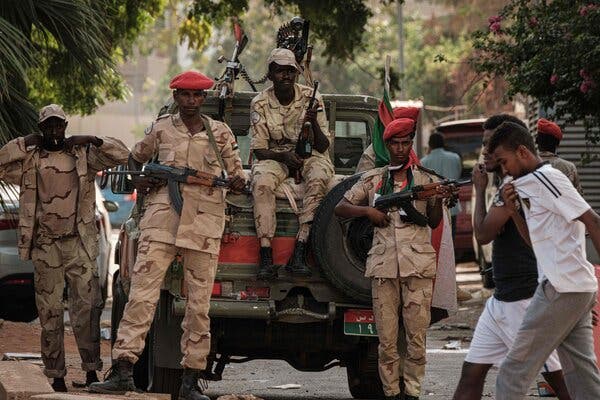
President William Ruto has expressed strong views on the ongoing conflict in Sudan, describing the Rapid Support Forces (RSF) and the Sudan Armed Forces (SAF) as “cut from the same cloth.” He argues that neither faction can provide a viable solution to the country’s crisis, emphasizing that both rely on military force rather than political dialogue.
In an interview with Al Jazeera in Doha, Ruto highlighted that the war in Sudan is not primarily a security issue but stems from governance failures. He called for a shift toward inclusive civilian leadership, suggesting that the current situation is a result of the overthrow of a people’s government.
“Both RSF and SAF are cut from the same cloth — they are a product of the overthrow of a people’s government,” Ruto said during the interview aired on Sunday. “These two generals have no solution for Sudan because both believe in solving problems using military means, which is not a security problem; it is a governance problem.”
Accusations Against Kenya
The comments came amid ongoing accusations from Khartoum that Nairobi is supporting the RSF. The RSF recently captured the city of El Fasher in western Darfur after an 18-month siege, leading to widespread starvation and reports of mass atrocities.
When questioned about claims by Sudan’s military government that Kenya supports the RSF — including alleged arms shipments through the United Arab Emirates — Ruto dismissed the allegations as false.
“Absolutely false,” he responded. “Kenya is a great democratic country — the only place in East and Central Africa where people can come and meet freely from every part of the world.”
Nairobi Meetings and Civil Society Engagement
Ruto explained that the controversial February meeting in Nairobi, cited by Sudan’s junta as evidence of Kenya’s involvement, was not an RSF political gathering but an assembly of Sudanese civil society, faith-based leaders, women’s groups, and activists discussing their country’s future.
“The meeting in Kenya was attended by civil society, church groups, Muslim leaders, and women. Such meetings have been held in Tripoli, in Addis — people come to Nairobi because it is a free space,” Ruto said. He noted that Kenya has faced similar claims from other nations in the region, insisting that all its dealings remain transparent.
“I can tell you for a fact that Kenya, being a democratic country, is often accused. DRC accused us — oh, there were people meeting in Nairobi. Sometimes I don’t even know they are meeting in Nairobi,” he said. “Because we are a free and democratic country, we do not ban people from coming to Nairobi. We just deal with criminals, not people who are seeking civil liberties and space to express themselves.”
Sudanese Junta’s Condemnation
Khartoum has repeatedly accused Nairobi of violating Sudan’s sovereignty after hosting the February meeting where RSF-aligned groups signed a declaration aimed at forming a parallel government. The Sudanese junta condemned the event as a “flagrant act of deception” and a “blatant violation” of international law, warning neighboring states against engaging with what it called an “illegitimate entity.”
Political Scrutiny and Allegations
Ruto’s remarks follow months of political scrutiny at home. In February, former Deputy President Rigathi Gachagua alleged that Ruto had business dealings with RSF leader Mohamed Hamdan Dagalo, known as Hemedti, including claims of involvement in illegal gold trade — allegations the government has denied.
Foreign Affairs CS Musalia Mudavadi has repeatedly defended Kenya’s neutrality, stating that the country’s engagement with Sudanese actors reflects its “commitment to peace and stability” in the region.
Renewed Fighting and Humanitarian Crisis
The latest statements also follow renewed fighting in Darfur, where the United Nations has reported summary executions, sexual violence, and mass displacement following the RSF’s capture of El Fasher. The RSF has since agreed to a US-backed humanitarian ceasefire proposal to allow aid access, though Sudan’s military leadership has yet to respond.
Civil war erupted in Sudan in April 2023 between the RSF, led by Mohamed Hamdan Dagalo, and the Sudanese Armed Forces under General Abdel Fattah al-Burhan. The conflict has created one of the world’s worst humanitarian crises, displacing millions and leaving over 25 million people in urgent need of assistance.