
A Journey Through the Legacy of Frankenstein
The character of Frankenstein has long captivated audiences, becoming one of the most frequently adapted figures in film history. From early silent films to modern interpretations, each generation has found something unique in the tale of the tragic creature. With over 423 feature films and 204 short films featuring some version of the monster, it’s clear that the story of Victor Frankenstein and his creation continues to resonate across time.
Now, Guillermo Del Toro has added his own distinctive touch to this rich legacy. His latest film,Frankenstein, starring Oscar Isaac, Jacob Elordi, and Mia Goth, brings a fresh perspective to Mary Shelley’s 200-year-old novel. The result is a visually stunning and emotionally powerful adaptation that feels like a gothic painting come to life.
The Icy Beginning
The film opens on a royal Danish ship trapped in the icy wilderness as its crew struggles to reach the North Pole. They encounter a burning boat surrounded by blood and rescue an injured man with a broken leg. As they attempt to navigate their way through the treacherous ice, they hear terrifying growls echoing across the frozen expanse. The sound signals the arrival of the monster, who soon attacks the crew.
In a tense confrontation, the creature kills several of the men before demanding, “Bring him to me.” He refers to the rescued man as Victor, revealing that this is none other than Victor Frankenstein himself. As the ship tips under the monster’s strength, the crew fires a final bullet that cracks the ice beneath the creature, sending him plunging into the freezing water below.
Part 1: Victor’s Tale
The film is divided into two parts, with Victor recounting his story to the ship’s captain. Flashbacks reveal his childhood in France, where he lives in a castle under the cruel rule of his father, a baron and surgeon who despises both Victor and his mother, Claire. A scene shows his father beating him with a cane after a failed lesson.
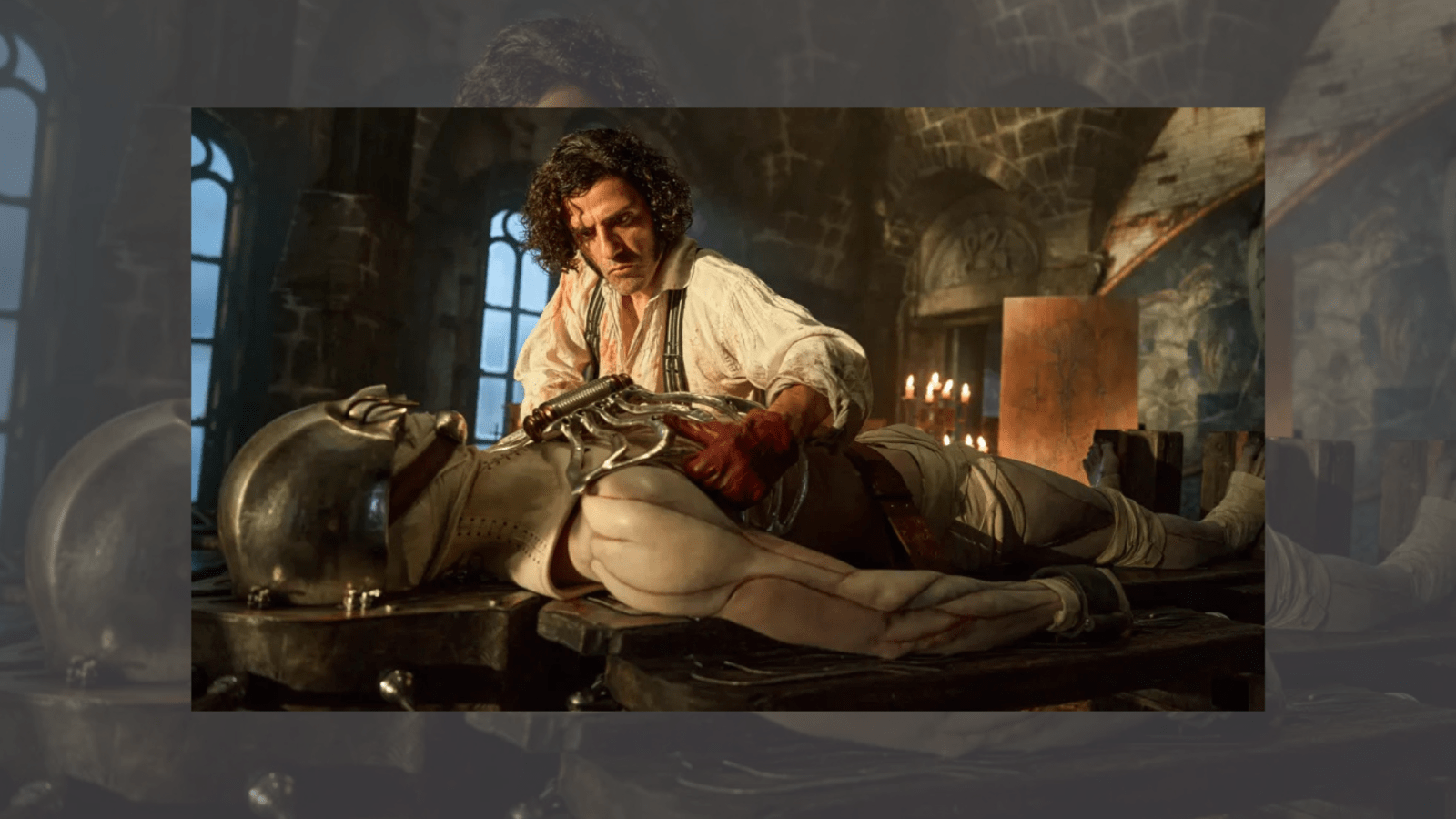
Victor’s trauma deepens after his mother’s death during childbirth, leading him to vow to conquer death itself. As an adult, he becomes a brilliant but unhinged surgeon obsessed with achieving eternal life. He presents his experiments to a horrified audience, claiming that his work is justified despite being labeled “unholy” by the public.
Supported by an arms dealer named Henrich Harlander, Victor begins his morbid experiments and falls for Harlander’s niece, Elizabeth (Mia Goth), who is engaged to Victor’s brother, William. Eventually, he succeeds in creating a nameless Creature (Jacob Elordi), but his triumph turns to torment when the Creature gains self-awareness, literacy, and a longing to understand his place in the world.
Part 2: The Creature’s Tale
After Victor’s failed attempt to kill his creation by burning down his home, the Creature survives and hides in a family’s house, where he secretly learns to speak. He eventually tells his side of the story to the ship’s captain, describing how he is hunted by men, befriends animals, and hides in an old mill.
The Creature even helps a family that believes a “spirit of the forest” watches over them. A blind old man, played by David Bradley, teaches him language and compassion, helping the Creature develop the soul of a poet. Unlike many adaptations that depict the Creature as mute, Del Toro restores his eloquence, staying true to Shelley’s original novel.
The Women of Frankenstein
Mia Goth shines in dual roles as both Victor’s mother and Elizabeth, making the two characters feel symbolically connected. Elizabeth, fascinated by insects and nature, mirrors the Creature’s search for belonging. Her white gown is inspired byThe Bride of Frankensteinand features bandage-like textures, visually linking her to the monster himself.
What I Loved
Every actor’s performance inFrankensteinis pitch-perfect. Oscar Isaac delivers a compelling portrayal of Victor Frankenstein, capturing both his brilliance and his terrifying obsession with overcoming death. His journey from a driven scientist to a man consumed by ambition is emotionally complex, and you understand his motivations even if you can’t condone them.
Del Toro’s Vision
Years ago, Guillermo Del Toro once said, “I’ve always been drawn to the idea of the monster as a misunderstood figure.” This film, after many years in the making, feels like the culmination of that dream. HisFrankensteinhumanizes the monster in ways few others have, offering a fresh and poignant take on the classic tale.
Final Thoughts
The film closes with the quote, “And really, that’s Frankenstein in a nutshell. It’s a story of broken hearts, enduring souls, and monsters who only wanted to be loved.”
Rating: ★★★★☆ (4/5)