
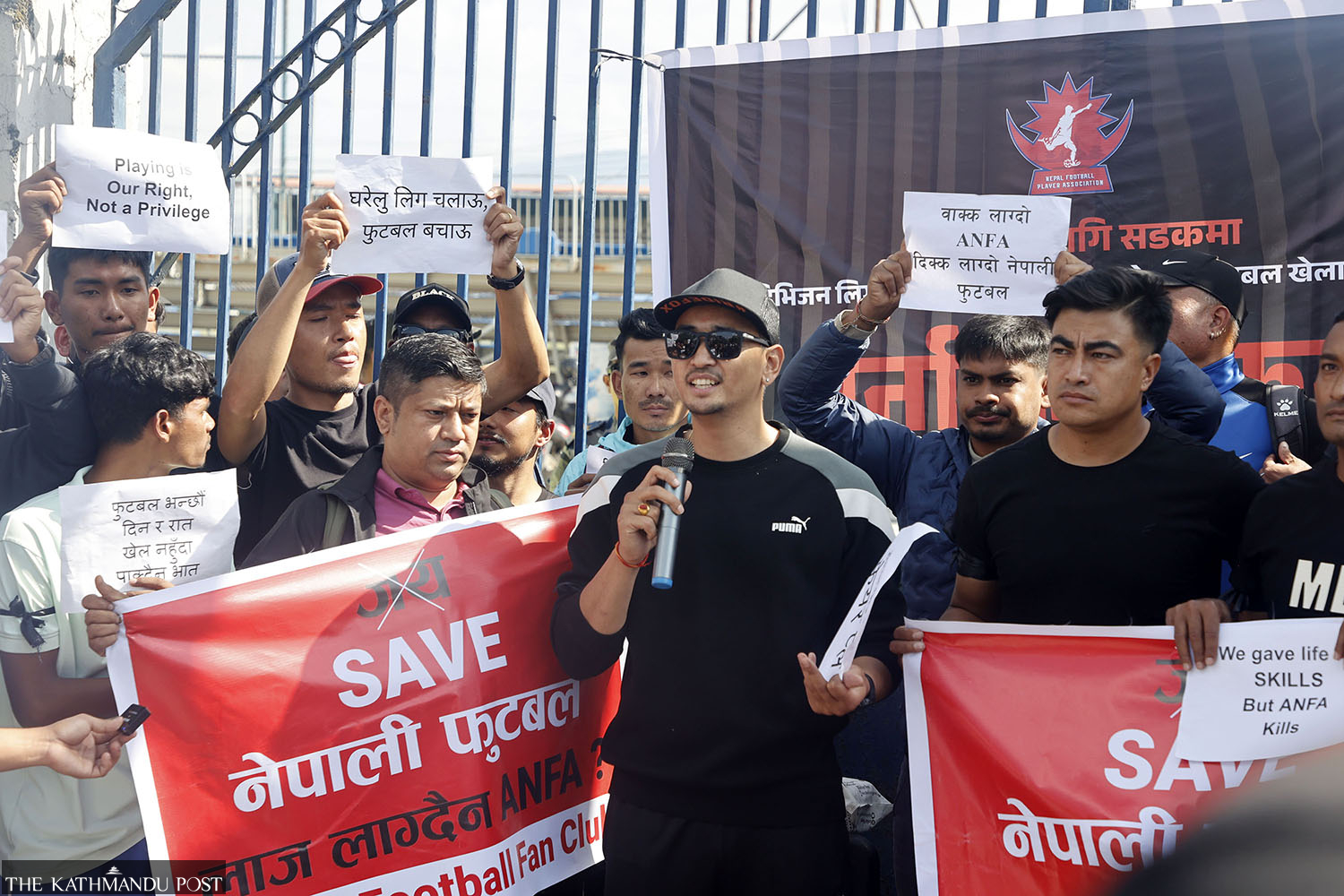
A Protest for the Future of Nepali Football
In a rare and striking display of dissent, footballers from across Nepal gathered at the ANFA Complex in Satdobato, Lalitpur, to protest against the postponement of the Martyr’s Memorial ‘A’ Division League. The event, which took place on Thursday around noon, saw players hanging their hard-earned medals outside the complex, a symbolic gesture of frustration and disappointment.
The protest was organized by the Nepal Football Player Association (NFPA), which represents domestic players who have been vocal about the lack of opportunities in the sport. The decision to delay the league for another year has been met with strong criticism, with many viewing it as a blow to the development of football in the country.
A Symbolic Gesture
Bikram Lama, the president of NFPA and a former national team player, spoke on behalf of the group. “We are leaving these medals as a souvenir, as a mark of thanks to the ANFA officials, who can wear these themselves,” he said. The players, who included legends like Anjan Bista and Rohit Chand, were seen kissing the medals before hanging them on the main gate of the complex.
The protest was not just a show of anger but also a plea for action. Players like Manish Dangi, Arik Bista, and Sanish Shrestha carried placards and chanted slogans demanding that the A Division League be held as scheduled. For many, the league is more than just a competition; it’s a platform for survival and growth.
The Impact on Players
Anjan Bista, one of Nepal’s all-time joint highest scorers, expressed his deep concern about the situation. “I have seen my brothers, my best friends, leaving the country and football in the absence of a regular league. It is disheartening because I was also without a platform to play for two years before I entered Bangladesh’s league this season.”
According to the NFPA, the postponement will affect between 1,250 to 2,100 players across the country. This has raised serious concerns about the future of football in Nepal, where the infrastructure is already struggling to support the sport.
Calls for Change
The protest also included former players such as Biraj Maharjan and coaches like Upendra Man Singh and Bal Gopal Maharjan. They emphasized the need for a structured league system that supports both current and emerging talent.
Futsal players were also part of the demonstration, highlighting the broader issues within the football ecosystem. Nepal’s national futsal team missed the 2026 AFC Futsal Asian Cup Qualifiers due to ANFA’s mismanagement, resulting in a $10,000 fine from the Asian Football Confederation.
Slogans and Silence
Chants such as “ANFA is having fun, while players are undervalued” echoed through the streets as the protest continued for over an hour. However, no high-ranking ANFA officials were present at the site, as they were reportedly busy outside the Kathmandu Valley.
ANFA president Pankaj Bikram Nembang and other officials were seen distributing footballs in Nawalpur as part of FIFA’s Football for School programme. This move has drawn criticism, with many questioning whether the leadership is more focused on campaigning for the upcoming ANFA election than addressing the concerns of the players.
A Call for Action
Suresh Shah, ANFA’s spokesperson, was the only official seen at the premises during the protest. He assured the players that their concerns would be forwarded to higher authorities. However, the NFPA remains determined.
“We will wait for a week,” Lama announced. “The answer we want is ‘A Division League will be organised this year’. If not, we will be forced to come out stronger than this.”
A Broader Movement
The protest has sparked a larger conversation about the state of football in Nepal. Fans, coaches, and referees joined the movement, showing solidarity with the players. As they sat outside ANFA’s main gate for a group photo, the players looked exhausted but resolute.
This is not the first time ANFA has faced criticism for its inability to host the league and implement necessary reforms. Yet, the administration continues to speak highly of its performance, even as the grassroots struggle for recognition and support.
The future of Nepali football depends on the willingness of its governing body to listen, act, and prioritize the needs of the players over political agendas. Until then, the protests and demands for change will continue.